


Bollywood, sexism and skin color: A brief study.
- Narendra Nath Banerjee

- May 9, 2021
- 3 min read
Part 1: The vamp
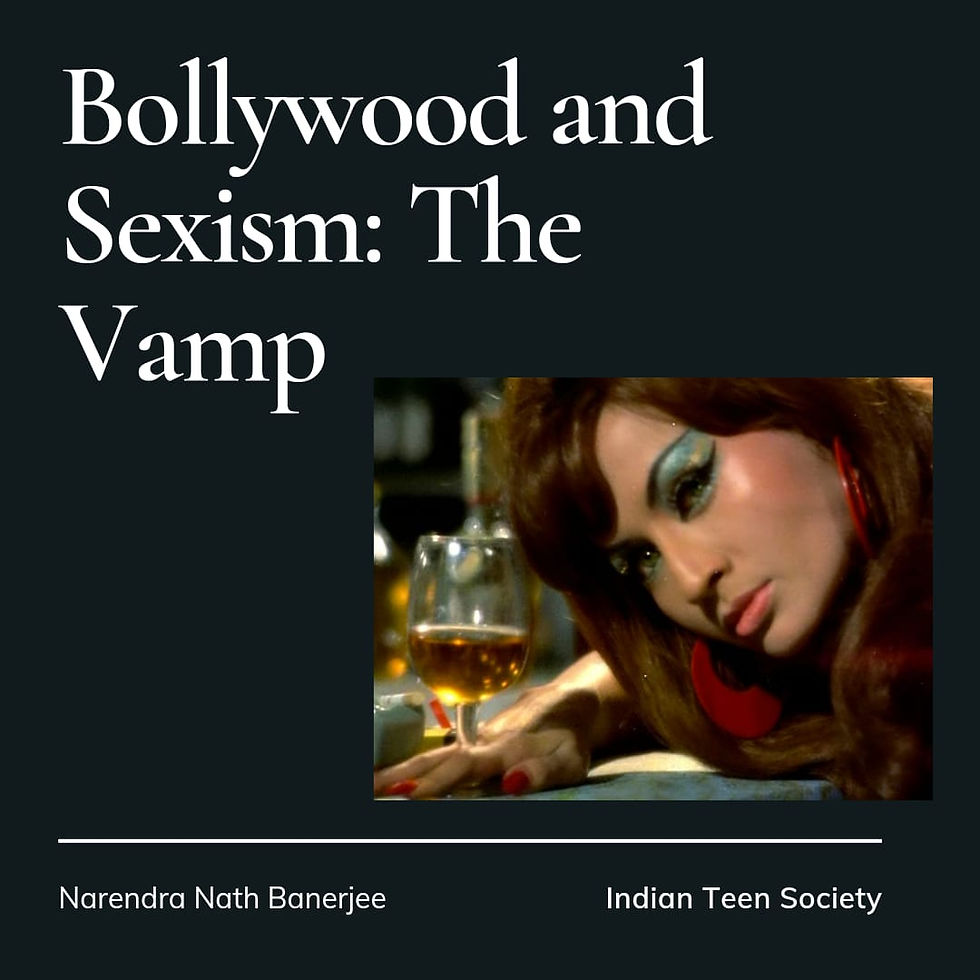
Movies have been with us since 1888. The first Indian film Raja Harishchandra started Bollywood ages ago in 1913. In this article, we do not intend to disrespect or offer critical commentary on any particular films. We will discover how the films, over the ages, have influenced skin and sexist stereotypes. Let us begin with today's topic: The Vamp.
To be fair, we all know the basics of Bollywood right? Women are either portrayed as wife, mother, lover or sister or she is portrayed as a vamp, prostitute or cabaret dancer. Mainstream Bollywood movies have exploited the roles of the vamp's character in almost every movie since its early days.
The vamp was always meant to be the counterfoil to the heroine's virtuous persona, the heroine was portrayed as the epitome of pureness, bravery and kindness, while the vamp was portrayed as impure, mean and selfish. Since early Bollywood cinema followed the archetype of pure women for the lead, the vamp was hyper-sexualised for bringing in more male audiences. This archetype set up in the 1940s was continued well into the 1990s as Indian cinema progressed from black and white to colour.
The vamp is neither the main villain nor his aid. There has always been a kind of love-hate relationship with the vamps since their inception. While actresses such as Lalita Pawar, Nadira and Manorama were mostly hated due to their evil scheming and hatred towards the morally correct heroine, Helen, Shahshikala and Bindu were hated due to their sometimes mean and boundaryless demeanour, but they were also adored due to their seductiveness. They were often present in bars or villains lair, and their main job was almost always to seduce the people present there.
Bollywood cinema during its early years was operating in a very narrow spectrum of pure good and pure evil. There were never any grey areas lying in between. In this scenario, the vamps became more hated. The lead actress may sing and dance, but it was the vamp who was fetishised and wore more revealing clothes and drank, smoked and sang in more openly sexual tones(Ofcourse Indian public hated that in the open, and enjoyed in private). Towards the beginning, when heroines were less in number, the lead was played by an upper-caste Hindu or Muslim, whereas the vamp was cast from different and unique races. This was done keeping in mind India's obsession with fair-skinned women and the vamps were thus made fair. These roles were also cast keeping in mind the liberal worldview of the actress because no respectable upper-caste woman would ever wear revealing clothes.
This archetype went on through the century before the advent of colour television and globalisation in the greater economics changed things up in the 1990s. The vamp's and the heroine's characteristics began getting merged so as to portray a larger shade of grey in the movies. This is especially noticeable in the movie Khalnayak. The heroine embarks on a journey to catch a hardened criminal and in the process has to sing and dance to lyrics with sexual innuendos. But she has not become impure because the ends justified the means. This was seen with heroes as well. Shah Rukh Khan popularised this through his movie Baazigar, becoming an anti-hero, who is the antagonist of the film.
Following this in the 2000s, Priyanka Chopra and Bipasha Basu led the movement of grey heroines through movies like Jism and Model. This, along with the need to show India being westernised and liberalised led to the removal of the vamp as lead actresses effortlessly merged the vamp with the heroine and also played by their own rules in terms of storytelling. And while there have been some new movies that have tried to break free of this and establish more strong roles for women, using women as the seductress in a moral dilemma while the hero has other challenges to overcome, is still a major plot point in Bollywood films.
The role and evolution of vamp from its early days to the modern-day provides an interesting characteristic to look at in Indian society. Literature, or rather art is an expression of what society is or strives to be. The vamp and her contributions to the cinema world have shown us that Indians have always enjoyed objectifying women as seductress and flashy, even if they think it is wrong. It is a known fact that Indians view sex as taboo, even though they enjoy it and derive pleasure, they hate talking about it in front. It is visible with the vamp. She is portrayed as immoral and impure but is also adored due to her flashy clothes and seductiveness.
If you want to support us, consider following us across our social media handles. The links of the same are given below:
Twitter: https://twitter.com/IndianTeenSoci1


Well done🤘